
Review · WALKING TOURS
Guatemala city Walking Tour and public bus
Guatemala City rewards curious walkers. This small-group tour links the Civic Center, Zone 1 churches, grand government buildings, Central Market, and Constitution Plaza while showing you how to ride the city bus. I like the simple start and finish, and I like that the public transportation fare is included. The main thing to consider is the pace: some people may find the two to two-and-a-half-hour outing slow, especially during longer explanations.
Guides such as Armando and Fidencio have made a strong impression with their friendly manner, clear English, and personal knowledge of the city. You should bring water, sunscreen, and a hat, since much of the route is outdoors. The tour ends in the heart of the historic center, giving you an easy base for more exploring, lunch, or a ride back toward the hotel zone.
In This Review
- Five useful things to know before you go
- Why this is a useful first look at Guatemala City
- Starting at the Civic Center and Miguel Ángel Asturias
- National Typography and the story of public information
- El Calvario and San Francisco churches
- The old communications palace
- Casa Ibargüen and the changing historic center
- Constitution Plaza and kilometer zero
- Metropolitan Cathedral and the Central Market
- Finishing with coffee at San Martín
- Getting back after the tour
- Who will get the most from this $30 tour?
- Should you book it?
- FAQ
- How much does the Guatemala City walking tour cost?
- How long does the tour last?
- Where does the tour begin?
- Where does the tour end?
- How many people can join the tour?
- What happens if the weather is poor?
Five useful things to know before you go
- You ride public transportation like a local: Your fare is included, and the guide can point you toward the Transmetro at the end.
- The route covers both modern and historic Guatemala City: Civic Center architecture gives way to churches, markets, government buildings, and colonial-era homes.
- The group stays small: A maximum of 15 people makes questions and street crossings easier to manage.
- Central Market is a highlight: You get a look at one of the city’s most practical and lived-in places, with time to explore or eat afterward.
- The tour begins and ends in convenient places: It starts near the Westin Camino Real and finishes at Plaza de la Constitución.
- The coffee stop costs extra: San Martín is the final stop, but coffee, tea, and lunch are not included in the $30 price.
Why this is a useful first look at Guatemala City
Guatemala City can feel spread out and difficult to read at first. This walk gives you a basic map of the center without asking you to arrange several taxis, buses, or separate admissions. You see major buildings in Zone 1, hear how the city developed, and get a short lesson in the local bus system.
The route also avoids making the city seem like only one thing. At the beginning, the Civic Center presents the modern government and financial side of Guatemala. Later, the route moves through churches, the old post office, public squares, and Central Market. That change of mood is one of the best reasons to book.
At $30 per person, the value comes mainly from the guide and the structure. No attraction admissions are included, and the tour does not include a meal or coffee. Still, the public bus fare is covered, and you are paying for local context, route planning, and a practical introduction to the capital.
The group limit of 15 is sensible. If few people book, you may receive something close to a private tour. One family with a small child had that experience with Fidencio, who answered questions patiently and helped them feel comfortable throughout the outing. Armando has also led private-feeling tours for small bookings, sharing information about government, Maya culture, architecture, and his own experience working in Guatemala City as a former firefighter.
More City Tours in Guatemala City
- Guatemala City Tour
★ 5.0 · 256 reviews - Antigua Guatemala Full-Day Shared City Tour
★ 5.0 · 84 reviews - Half-Day Guatemala City Tour
★ 5.0 · 82 reviews
Starting at the Civic Center and Miguel Ángel Asturias
The meeting point is the Westin Camino Real on Avenida La Reforma, with a scheduled start at 10:30 a.m. From there, the tour uses public transportation to reach Estación Centro Cívico. This opening move matters because you are not simply being driven between sights. You begin learning how the city connects.
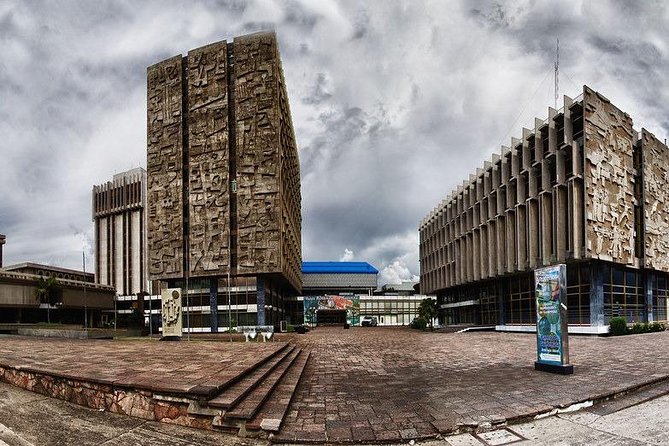
At the Civic Center, you look around the City Hall, Banco de Guatemala, Banco Crédito Hipotecario Nacional, and Social Security offices. The stop lasts about 15 minutes. These buildings help explain the civic and economic role of the area, and they offer a different view of Guatemala City from the colonial streets you see later.
The tour also introduces the work of engineer Recinos, who was responsible for monitoring, constructing, and creatively developing the building now known as the Guatemalan Cultural Center Miguel Ángel Asturias. The information gives the Civic Center more meaning than a quick photograph from the street.
Do not expect a long interior visit here. Admission is not included, and the time is designed for an overview. I would treat this stop as a visual introduction to the city’s public architecture, not as a museum visit.
National Typography and the story of public information
The next stop is the Dirección General del Diario de Centro América y Tipografía Nacional. You have about 20 minutes to look at the building and hear how the National Typography moved through different phases of the city’s development.
The first National Typography building operated from 1894 to 1918 on what was then called Hospital Street, at 2nd South Avenue and 10th Street. In 1935, President Jorge Ubico ordered construction of a new building for the National Typography. That detail gives you a direct link between the city’s streets, its government, and the production of public information.
For you, the value is in the explanation. A building that might look like another old government office becomes part of the story of newspapers, printing, and state power. The stop is brief enough to keep the route moving, though the guide may spend much of the time talking rather than walking.
El Calvario and San Francisco churches
Parroquia Rectoral Nuestra Señora de los Remedios, commonly called El Calvario, is next. The present church is tied to an earlier location on Cerro del Cielito at the end of Sixth Avenue. In 1936, that earlier building became the National Museum of History, and it was later demolished to make room for road expansion.
The stop lasts about 10 minutes, so you should expect a short explanation and a look around rather than a full church tour. It is still a useful piece of city history because it shows how road building and urban growth changed old religious sites.
The route then reaches Iglesia San Francisco, another 10-minute stop. This Catholic temple belongs to the conventual Franciscan friars and sits within the historic center. It is also part of the territory of the Parish of Our Lady of Remedies.
These two churches work well together. You can compare their place in the city’s religious network and see how the historic center mixes daily worship with older architecture. If you want long periods for quiet observation or photography, the timing may feel short. If you want a broad introduction, the quick stops help you cover more ground.
More Walking Tours in Guatemala City:
- Guatemala City: Walking Tour
★ 4.9 · 42 reviews - Guatemala city walking tour only weekends. 2 persons and up
★ 4.5 · 11 reviews - Graffiti Walking Tour in 4 Grados Norte Guatemala City
★ 5.0 · 9 reviews - Historic and Cultural Tour of Guatemala City – Panoramic & Walking Experience
★ 4.5 · 4 reviews
The old communications palace
The General Directorate of Posts and Telegraphs is one of the route’s most distinctive public buildings. Formerly called the Palacio de Comunicaciones, it was designed by Rafael Pérez de León and Enrique Riera during the government of Jorge Ubico.
Construction began in 1938. The first phase opened two years later as part of the president’s birthday celebrations, and two more phases followed over the next five years. You spend about 15 minutes here.
I like this stop because it shows how communications once shaped the capital. A post and telegraph building was not merely a service counter. It represented the country’s connection with itself and the outside world. The guide’s explanation helps you notice the building as part of a larger state-building project.
As elsewhere on the route, admission is not included. The experience is primarily from the street and through the guide’s account.
Casa Ibargüen and the changing historic center
Casa Ibargüen receives the longest individual stop, about 30 minutes. The house in Zone 1 was once the Beltranena palace, built in 1778. Today it serves as the headquarters of the Foundation of the Historic Capital Center.
That change in use captures the larger story of central Guatemala City. An old private palace now has a role in caring for and promoting the historic center. You get time to look at the building and place it within the city’s architectural past.
The 30-minute pause can be either a benefit or a drawback. If your guide is explaining the area, answering questions, and pointing out details that are easy to miss, the extra time feels worthwhile. If you prefer a brisk walking tour, this is the point where the route may feel slow.
The tour’s overall timing depends on how much the guide explains and how long the group takes to move between stops. Although the advertised duration is about two to two-and-a-half hours, the listed stop times add up to a substantial portion of that period. Plan for a relaxed outing, not a rapid checklist.
Constitution Plaza and kilometer zero
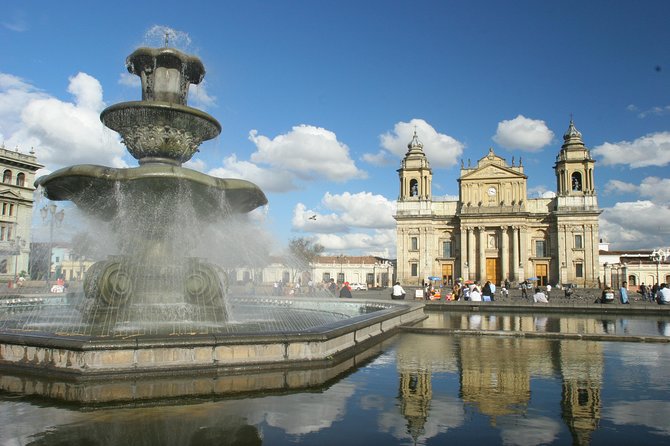
Plaza de la Constitución is the natural center of the tour and the place where it ends. Also called Central Park, the square is bordered by the National Palace to the north, Metropolitan Cathedral to the east, Portal of Commerce to the south, and Centennial Park and the National Library to the west.
This is a good place to pause and understand Guatemala City’s civic life. Independence celebrations, parades, concerts, speeches, protests, and public gatherings take place here. The plaza has also been connected with the Huelga de Todos los Dolores, a student parade of the University of San Carlos known for satire and criticism of the government.
The main entrance of the National Palace is considered kilometer zero for roads across Guatemala. That is a small but memorable detail, and it helps you see the square as more than an open space between buildings.
You have about 15 minutes here during the formal route. Afterward, you can continue at your own speed. The ending is practical: you are already in Zone 1, with the cathedral, market, historic streets, and other sights close by.
Metropolitan Cathedral and the Central Market
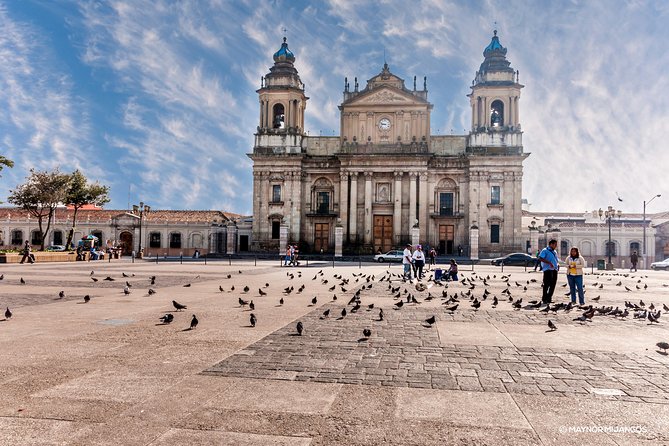
The Catedral Metropolitana de Santiago de Guatemala is a key stop, with about 15 minutes set aside. The cathedral has witnessed more than two centuries of political and religious change, including two major earthquakes, independence, and revolution.
The Carrara marble altar was installed on July 23, 1860. That date gives you a concrete detail to remember as you look inside. The cathedral’s importance comes not only from its age, but also from the events that shaped it and the city around it.
Next comes Mercado Central, with about 20 minutes. The market occupies ground near the cathedral that once included an abandoned square, the old Plazuela de El Sagrario, a partly ruined temple, and a cemetery. Before the independence of the Kingdom of Guatemala, the area had already become a complicated mix of sacred land, burial ground, and public space.
Dr. Mariano Gálvez proposed converting the unhygienic square into a market. Plans were delayed after the cemetery was moved and newly exhumed bodies were blamed for the appearance of cholera. Church authorities also resisted because the ground was considered sacred and belonged to the Church.
This background makes the market more interesting. You are not merely entering a place to buy food. You are seeing the result of a long argument about sanitation, commerce, religion, and public needs.
The market is one of the strongest parts of the outing for anyone who wants ordinary city life rather than only official monuments. You might find the 20 minutes enough for an introduction, but not enough for a leisurely meal and extended shopping. If you want to eat there, ask the guide how much time is available.
Finishing with coffee at San Martín
The last stop is San Martín in the historic center, with about 30 minutes. The restaurant and bakery occupy the old Pavón House on Paseo de la Sexta and 10th Street. The building was revitalized for the San Martín chain, giving you another example of an older property being put to modern use.
Coffee or tea is not included, and lunch is also separate. That is easy to manage if you simply want to finish with a drink, but you should budget extra if you plan to eat.
A family on a private-feeling outing ate a local lunch at the Central Market, so the route can be adapted to food if your guide and timing allow. Do not assume that a full meal is part of the $30 cost. It is better to see San Martín as an optional final pause, not a prepaid restaurant stop.
Getting back after the tour
The formal endpoint is Plaza de la Constitución. From there, you have free time to continue walking or return to your hotel. The guide can take you to the Transmetro and point out where to get off in the hotel area.
That help is especially useful if public buses are new to you. The included fare keeps the cost simple, while the guided ride gives you a practical look at how residents move around the city. You should still keep your belongings secure and stay with the group during street crossings and transfers.
The experience is suitable for most people who can participate in a normal city walk and use public transportation. Since the route is outdoors and the weather can affect the departure, wear comfortable shoes and carry sun protection. The operator offers a different date or a full refund if bad weather cancels the tour, and free cancellation is available up to 24 hours before the start time.
Who will get the most from this $30 tour?
I would choose this tour if you have limited time in Guatemala City, want a guided introduction to Zone 1, or feel unsure about using public transportation alone. It is also a good first activity before returning to the historic center independently.
The tour suits people who enjoy architecture, public history, churches, markets, and local transport. It also works well for families when the group is small and the guide is as patient as Fidencio was with questions from a child.
I would think twice if you want a fast-paced walk with long interior visits. The tour can feel slow during its explanatory sections, and no admission tickets are included. It is best for someone who values context and orientation more than ticking off as many sights as possible.
Should you book it?
Book this Guatemala City walking tour if you want an affordable, guided first look at the capital with a real public-bus ride built in. The mix of Civic Center architecture, old religious buildings, Constitution Plaza, Central Market, and San Martín gives you a useful sense of how the city works.
The strongest reason to choose it is the guide. Armando and Fidencio have been praised for friendly service, clear English, patience, and personal experience of the city. If you prefer to move quickly or spend time inside major buildings, choose another format. If you want local orientation, practical transportation help, and a compact route through Zone 1, $30 is a fair price.
FAQ
How much does the Guatemala City walking tour cost?
The tour costs $30 per person. Public transportation is included, but coffee, tea, lunch, and admission tickets are not included.
How long does the tour last?
The estimated duration is two to two-and-a-half hours.
Where does the tour begin?
The meeting point is the Westin Camino Real on Avenida La Reforma in Guatemala City. The scheduled start time is 10:30 a.m.
Where does the tour end?
The tour ends at Plaza de la Constitución, also called Central Park, in Guatemala City.
How many people can join the tour?
The maximum group size is 15 people. If only a few people book, the outing may feel close to a private tour.
What happens if the weather is poor?
The experience requires good weather. If poor weather causes cancellation, you will be offered another date or a full refund. You can also cancel up to 24 hours before the start time for a full refund.
Just added around Guatemala City
- Graffiti Walking Tour in 4 Grados Norte Guatemala City★ 5.0 · 9 reviews
- Tikal Shared Experience: Flight from the City + One Day Tour★ 5.0 · 4 reviews
- Transfer from Airport to Antigua★ 5.0 · 4 reviews
- Guatemala City Panoramic Tour + Visit to the Central Market★ 5.0 · 9 reviews
- Small-Group Cooking Class in Antigua from Guatemala City★ 5.0 · 5 reviews
- Private Transportation Service Within Guatemala City on a Minibus with A/C★ 4.5 · 3 reviews
- Private transportation Guatemala to Panajachel★ 5.0 · 2 reviews
- Guatemala San Jose Beach Private Tour★ 5.0 · 3 reviews
Walking Tours, compared.
Antigua Classic Cultural Walking City Tour – the best
Read our review →
Walking Tour of the Wonders of La Antigua Guatemala
Read our review →
Browse the lists this tour appears in