
Review · COFFEE EXPERIENCES
Coffee Tour Adventure Antigua Guatemala
Coffee tells you a lot about Guatemala. This tour takes you past the café counter and into the work behind the cup, with a local farmer, a short country walk, and hands-on roasting at the farmer’s home. I especially like the small-scale farm setting and the chance to roast, grind, and prepare your own coffee. The main thing to consider is the uphill walk on rocky, dusty ground, so closed shoes are a smart choice.
The experience begins in San Pedro Las Huertas, a short distance from Antigua, and lasts about two to three hours. At $30 per person, it offers more than a tasting: you learn about coffee plants, rural life, local crops, and the effort required to produce small-batch beans. Transportation needs careful attention, since private transport is not included and the stated meeting point is the San Pedro Las Huertas bus station.
In This Review
- Key points to know before you book
- Starting in San Pedro Las Huertas
- Walking toward the coffee farm
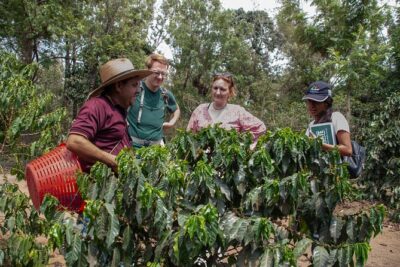
- Meeting the coffee farmer
- Following the coffee from plant to bean
- Coffee at the farmer’s home
- The guides make a big difference
- Is $30 a fair price?
- Who will enjoy this experience most?
- Practical advice for a smoother visit
- Should you book the Antigua coffee tour?
- FAQ
- Where does the coffee tour begin and end?
- How long does the experience last?
- How much does the tour cost?
- Is lunch included?
- Is private transportation included?
- What will I do during the coffee experience?
- Is the tour suitable for most people?
- What happens if bad weather cancels the tour?
Key points to know before you book
- Coffee from seed to cup: Learn how beans are planted, grown, harvested, sorted, roasted, ground, and brewed.
- A real family farm: Meet a local coffee producer and visit the home where the beans are prepared.
- Hands-on work: You can roast and grind beans yourself, then drink the coffee you helped make.
- More than coffee: Guides point out fruits, plants, and medicinal uses along the route, while also explaining local life and Antigua’s past.
- A short but uneven walk: The route can include an uphill stretch of about 20 minutes on a rocky or dusty road.
- Small groups: The maximum group size is 20, though some departures have been very intimate, even with just one participant.
Starting in San Pedro Las Huertas
San Pedro Las Huertas gives the tour a useful sense of place before the coffee work begins. The village park has two traditional wash basins, known locally as pilas, that remain in use. These are not museum pieces placed behind glass. Local people still use them, giving you a quick look at everyday community life.
You also receive an introduction to the village church, including its colonial Spanish history and architecture. The stop is brief, about 10 minutes, but it adds context. Coffee production here is not an isolated tourist activity. It belongs to a rural setting shaped by village customs, agriculture, family work, and the long history of the Antigua area.
The tour description lists the bus station in San Pedro Las Huertas as the meeting point and return point. Some arrangements described by past participants included pickup and drop-off near Antigua accommodations, but private transportation is not included in the stated package. I would confirm your exact pickup plan before setting out, especially if you are staying in central Antigua.
More coffee farm tours around Antigua:
- Antigua ATV Coffee Tour
★ 5.0 · 380 reviews - Coffee and Gastronomic Bike Tour in Antigua
★ 5.0 · 284 reviews - Experience: Organic Coffee, Avocados, Honey & More!
★ 5.0 · 101 reviews
Walking toward the coffee farm
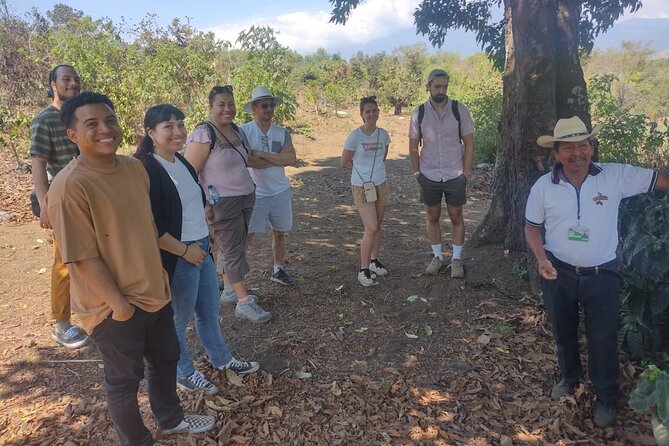
From the village, the experience moves toward the coffee-growing area. The walk is part of the lesson, not just a way to fill time. Guides and farmers identify plants and crops along the route, and you may hear about their uses in Guatemalan cooking or traditional medicine.
The walk has been described as easy by some people, but it is not a smooth city stroll. A roughly 20-minute uphill section can be rocky, dusty, and muddy, depending on conditions. Tennis shoes may work, but closed walking shoes or hiking boots are a better choice. Wear something you do not mind getting dirty.
Some departures use a 4×4 ride to reach the coffee fields, and the uphill drive has been praised for its views. Since the core details do not guarantee that option for every booking, ask about it in advance if the ride matters to you. The route may also offer views toward nearby volcanoes and surrounding farmland, though exact conditions depend on weather and the day’s arrangement.
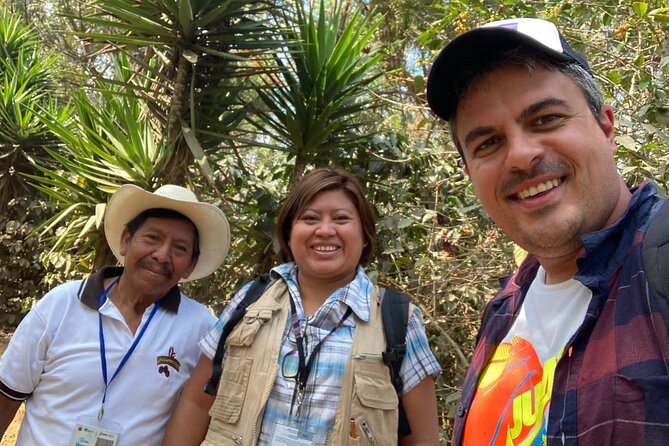
The pace is one of the tour’s strengths. You are not rushed from one display to another. There is time to stop, ask questions, and notice how coffee grows beside other crops. Guides such as Axel, Louis, and Delmy have been praised for explaining not only coffee but also Guatemalan culture and local history. Axel, in particular, often serves as an English-speaking guide and translator.
Meeting the coffee farmer
The heart of the experience is the meeting with a small local producer. Depending on the departure, you may meet farmers named Martha, Filiberto, or Cristobal. The farmer explains the work in practical terms, while the guide helps translate when needed.
This arrangement matters because you see coffee as family labor rather than as a polished factory product. Small-batch production involves careful planting, tending, harvesting, sorting, drying, roasting, and grinding. The work is physical and time-consuming, and the tour gives you a clearer sense of what is behind the price of a quality cup.
The farm may be modest. That is part of the point. You are not touring a large commercial operation with rows of signs and a staged demonstration. You are seeing how coffee can be grown and prepared in a local setting, with the farmer sharing knowledge from daily experience.
That direct contact also gives the tour a human side. The farmer’s home becomes part of the experience, and the visit supports small producers and the surrounding community. If you prefer polished facilities, formal tasting rooms, and industrial machinery, this may feel basic. If you want to understand how coffee fits into ordinary Guatemalan life, the simplicity is a real advantage.
Following the coffee from plant to bean
The coffee lesson covers the full chain from seed to cup. You learn how coffee plants grow, what the beans look like, and how harvesting affects the final drink. The guide and farmer may also discuss nearby plants and crops, which helps place coffee within a broader farming system.
Sorting is an important hands-on step. You are shown how to separate better beans from lower-quality ones before roasting. This small task makes the process easier to understand. A bag of beans can look uniform at first, but careful selection is part of producing a clean, good-tasting brew.
Roasting brings the biggest change. Green or lightly processed beans become dark, fragrant, and ready for grinding. The activity is done in a simple household setting, often over a stove, rather than with a large commercial roaster. You get to participate instead of watching from a distance.
Grinding by hand slows the process down in a useful way. It takes effort, and that effort makes the final cup feel earned. You begin to understand why coffee production is not just an agricultural matter but also a series of small decisions and repeated tasks.
More Antigua days worth putting side by side
- Antigua Cultural Walking Tour
★ 4.5 · 725 reviews - Hike to Pacaya Volcano from Antigua
★ 4.5 · 502 reviews - Antigua ATV Sunset Tour
★ 5.0 · 488 reviews - Authentic Guatemalan Cooking Class in Antigua
★ 5.0 · 438 reviews
Coffee at the farmer’s home
After the farm portion, you are welcomed into the farmer’s home to continue the preparation. This is one of the most personal parts of the outing. You sort beans, roast them, grind them, and help make the coffee you will drink.
The final brew has been described as a rustic, cowboy-style coffee. It may be served with cookies, and you can usually buy additional coffee to take home. One account gives the price as 60 Guatemalan quetzales per bag, but the supplied tour details do not guarantee the size or current price, so bring some local currency if you hope to purchase beans.
The tasting is not presented as a formal barista class. You should expect a simple, local preparation that puts the flavor and the work first. That is exactly why it works. After handling the beans yourself, the cup has a clear connection to the farm and the family who produced it.
Even people who do not normally drink coffee may find this part worthwhile because the focus is cultural as much as culinary. The experience explains why coffee matters in Guatemala and how much work can go into a product many people consume without thinking.
The guides make a big difference
The quality of this tour depends heavily on the guide and the farmer. The strongest guide names associated with the experience are Axel, Louis, and Delmy, while Martha, Filiberto, and Cristobal have hosted different departures.
Axel is often praised for his English, humor, and ability to translate the farmer’s explanations in clear terms. Louis has also been described as friendly and attentive, helping bridge the language gap with Martha. Delmy has been praised for answering broader questions about Guatemala as well as coffee.
Because the farmer may speak little English, a translator is important if you want detailed explanations. The language barrier does not necessarily prevent a good visit, but the quality of interpretation can shape how much you learn. If you have specific questions about farming, ask them during booking or at the start so the guide can make time for them.
The group limit is 20 people. That is still a manageable size for a walking tour, but actual group sizes can vary. Some departures have been private in practice, with one person or one couple receiving very close attention. Do not assume you will have a private tour, but the maximum keeps the activity from becoming a huge crowd.
Is $30 a fair price?
At $30, this is a strong value if you want contact with local people and active participation. You are paying for a two to three hour experience that includes village context, a farm visit, interpretation, a walk, the coffee process, and a fresh tasting.
The value also comes from what the tour does not try to hide. You see the labor involved in small-scale production and visit a farmer’s home instead of staying in a showroom. The money helps support small producers and the local community, which gives the price a practical purpose beyond entertainment.
Lunch is not included, so plan to eat before or after the outing. Private transportation is also not included, and the stated meeting point is the San Pedro Las Huertas bus station. Those extras could affect your total cost, especially if you need to arrange a taxi or other ride from Antigua.
I would compare this with a large estate tour only if you want machinery, formal processing facilities, or a more polished tasting. For a personal look at family farming, the $30 price is reasonable.
Who will enjoy this experience most?
I would recommend it first to coffee drinkers who want to understand where their coffee comes from. The hands-on roasting and grinding make the lesson stick far better than a talk alone.
It also suits people who want a rural side trip from Antigua. You learn about crops, local customs, village architecture, and family life as you move through the area. The tour can work well for solo visitors, couples, and families, provided everyone can manage the walk.
You should think twice if you need step-free access, dislike uneven ground, or want a fully climate-controlled activity. The tour takes place outdoors and requires good weather. Service animals are allowed, and most people can participate, but the route’s uphill and rocky sections still deserve attention.
It is also a good choice if you care about community-based tourism. The farmer is not just a performer brought in for a staged tasting. You meet the person doing the work, enter the family setting, and gain a more honest view of coffee farming’s rewards and difficulties.
Practical advice for a smoother visit
Wear closed shoes with a firm sole. Dust and mud are possible, and an uphill path may be rocky.
Bring water, sun protection, and a light layer for changing mountain weather. These are sensible choices for any outdoor activity around Antigua, though the tour details do not specify what equipment is supplied.
Allow two to three hours, and leave extra time around the start and end if you must connect with another activity. The group returns to the meeting point, but transport to and from Antigua should be confirmed before booking.
If you want to buy coffee, carry quetzales. A past purchase price was 60Q per bag, and buying directly from the family gives you a useful souvenir with a clear connection to the place.
Finally, keep your questions coming. Ask about plant varieties, harvesting, local crops, roasting, and the farmer’s work. The guides are there to interpret, and the best part of this tour is the conversation.
Should you book the Antigua coffee tour?
Book it if you want a personal, hands-on coffee experience rather than a quick tasting. The strongest reasons are the visit to a working small farm, the time in the farmer’s home, and the chance to prepare your own cup from roasted beans.
I would not choose it for a luxury estate visit, a formal coffee certification class, or a guaranteed private transfer. The walk can be dusty, the facilities are simple, and transport details need confirmation.
For most people spending a few days in Antigua, this is a worthwhile half-day outing. It connects a familiar drink with local work, family life, and the countryside just beyond town. At $30, it offers a rare chance to leave Antigua’s cobbled center and understand what makes Guatemalan coffee more than a menu item.
FAQ
Where does the coffee tour begin and end?
The stated meeting point is the bus station in San Pedro Las Huertas, Guatemala. The activity ends back at the same meeting point.
How long does the experience last?
The tour takes approximately two to three hours.
How much does the tour cost?
The listed price is $30 per person.
Is lunch included?
No. Lunch is not included in the tour price.
Is private transportation included?
No. Private transportation is not included. Some arrangements may offer transport options, so confirm your pickup details before the tour.
What will I do during the coffee experience?
You learn about coffee from seed to cup, visit the growing area, sort beans, roast them, grind them, and prepare coffee to drink.
Is the tour suitable for most people?
Most people can participate, and service animals are allowed. The route can include an uphill walk on rocky or dusty ground, so closed shoes are recommended.
What happens if bad weather cancels the tour?
If poor weather causes cancellation, you will be offered another date or a full refund. Free cancellation is available when you cancel at least 24 hours before the start time.
Just added around Antigua
- The old UNESCO★ 5.0 · 3 reviews
- Lake Atitlan★ 5.0 · 2 reviews
- Walking Tour Antigua, an open Museum★ 5.0 · 4 reviews
- Worry Doll Workshop with Doña Rosa★ 4.5 · 2 reviews
- Volcan Pacaya on wheels ATV From Antigua or Guatemala city.★ 5.0 · 4 reviews
- Private Day Tour of Magic and Nature in Cascades of Urlanta★ 4.5 · 2 reviews
- Village Tour in Antigua Guatemala★ 5.0 · 4 reviews
- Private Transfers in Guatemala★ 3.5 · 3 reviews
Coffee Experiences, compared.
Experience: Organic Coffee, Avocados, Honey & More!
Read our review →
San Salvador: Full Day Ruta de Las Flores and Coffee Farm
Read our review →

Browse the lists this tour appears in